

How it works
Four steps from “this car has to go” to money in your account, with the paperwork handled properly. The only phone call is ours, to agree the collection day.
- 1
Get your price
Enter your registration and postcode. We pull the vehicle's details from the DVLA record — make, model, year, fuel type and kerb weight — and price it against current scrap metal values, parts demand for that model, and what it costs us to collect from your area.
Then you answer a handful of questions about condition. Does it start? Do all four wheels turn? Is the catalytic converter still fitted? Each answer moves the price up or down, and you see the effect immediately.
- 2
Accept and book a collection
If you are happy with the figure, tell us the day that suits you. We ring you to agree the day and a morning or afternoon slot, and confirm it by email. Collection is free — there is no charge for recovery, even for a vehicle that has not moved in years.
- 3
We collect the vehicle
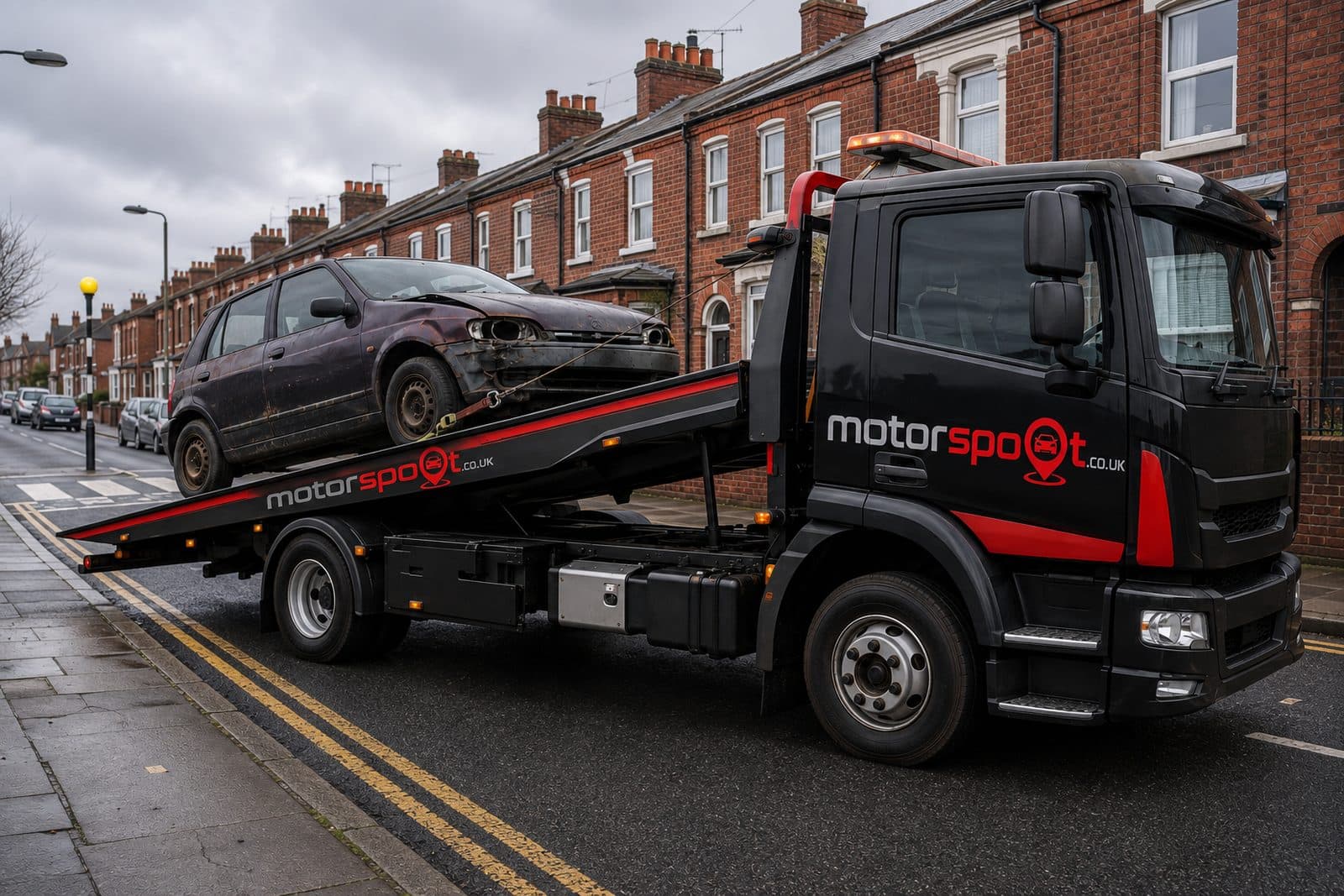
Our own driver — or, on the longer runs, one of our approved collection partners — comes to the address you gave us. They will check your photo ID and proof of address — this is a legal requirement, not us being awkward — confirm the vehicle matches what you described, and load it onto the truck.
If the vehicle is genuinely not as described (the engine is missing, say, when you told us it was complete), the driver will explain the revised figure before anything is loaded. You are free to say no.
- 4
You get paid and we handle the DVLA
The vehicle comes back to our own Authorised Treatment Facility in Mexborough and is checked in; your payment then goes out by bank transfer — the same day for collections made before 3pm, the next working day for later ones. We notify the DVLA that you are no longer the registered keeper, and we send you the Certificate of Destruction we issue there.
Scrapping a car the legal way
A few things are worth knowing, because plenty of operators cut corners on them.
It is illegal to be paid in cash
The Scrap Metal Dealers Act 2013 bans cash payments for scrap metal, including vehicles, in England and Wales. Anyone offering you notes on the driveway is breaking the law — and it is a sign the vehicle may not be disposed of properly either.
The vehicle must go to an Authorised Treatment Facility
Only an ATF can legally depollute and destroy an end-of-life vehicle, and only an ATF can issue a Certificate of Destruction. Our yard in Mexborough is one: Environment Agency permit BB3507XB, waste carrier registration CBDU237104 — both can be checked on the Environment Agency public register.
You must tell the DVLA
Until the DVLA has been notified, you remain the registered keeper — and liable for tax, insurance and any fines. Our Certificate of Destruction updates the record, but GOV.UK asks you to tell the DVLA yourself as well: two minutes online with the 11-digit reference from the V5C, or the yellow V5C/3 section by post.
Keep your Certificate of Destruction
It is your evidence that the vehicle was destroyed legally and that your liability has ended. We email it to you; keep it with your records.
What if I have lost the V5C?
We can still buy the vehicle. There is a little more paperwork and a small deduction to cover it, and the driver will need to see photo ID and proof of where you live now — an old address on the DVLA record is not a problem. More on scrapping without the V5C
What about a private plate?
Take the registration off before you book the collection. Once the vehicle has gone to an ATF and been destroyed, the plate cannot be retained. You can apply to keep a registration on GOV.UK.
Ready to see your price?
Takes about 30 seconds. No email address required.